


“`html
Exciting news from Coinbase Ventures! They’ve rolled out a clear plan highlighting where they see the future of crypto value creation by 2026. The focus is on real-world asset perpetuals, specialized exchanges, “next-gen DeFi,” and the remarkable fusion of crypto with AI and robotics. This guide answers a popular question among founders: “What should I build next?” Plus, they’re on the lookout for the perfect teams to support in these areas!
According to their team, 2025 brought a quiet but powerful reset for crypto. They point out that the “stablecoin infrastructure is revolutionizing payments,” along with cross-chain solutions slashing settlement times “from days to mere moments.” New decentralized exchange (DEX) models are now paving the way for “markets for everything on-chain.” Despite the ups and downs in prices, Coinbase Ventures states: “We’re still incredibly optimistic about what’s coming next!”
Key Crypto Trends to Watch in 2026
The first big theme is real-world asset derivatives. Kinji Steimetz explains that “RWA perpetuals” are popping up as the quickest way to bring off-chain assets into the crypto world. He describes perpetuals as “crypto’s most tried-and-true trading product,” offering a faster and more adaptable route than traditional tokenization.
Since perpetuals don’t need custody of an underlying asset, Coinbase Ventures predicts “the perpification of everything,” creating markets around almost anything, from private companies to economic indicators. Steimetz also connects this to macro integration, highlighting how savvy crypto traders will look for on-chain exposure to “oil, inflation breakevens, credit spreads, and volatility.”
Next up is market structure and trading interfaces. Steimetz highlights “Prop-AMMs” on Solana—where liquidity is executed only via aggregators, providing protections for liquidity providers against “predatory flow.” This “prop-driven approach,” they believe, could advance market structure innovation ahead of foundational improvements and isn’t limited to just Solana.
At the same time, Coinbase Ventures sees prediction markets as one of the most promising consumer crypto applications, though they’re still facing fragmentation similar to early DeFi. Jonathan King anticipates the rise of “prediction market aggregators” becoming the “main interface layer,” consolidating over $600 million in liquidity. Imagine trading terminals with “advanced order types, filters/charts, multi-venue routing, position tracking, cross-venue arbitrage insights, and more!”
Under the umbrella of “Next-gen DeFi,” the firm emphasizes three key areas: composable perp markets, unsecured credit, and privacy. They assert that perpetual futures are evolving from standalone venues into essential components for capital-efficient systems, allowing users to “hedge, earn, and leverage all at once without sacrificing liquidity.” According to Coinbase Ventures, perp DEX volumes have hit around $1.4 trillion monthly, growing about 300% year-over-year. They expect 2026 to further integrate with lending protocols to enable collateral to earn yield while supporting leveraged positions.
On the topic of credit, King describes unsecured credit-based money markets as “the next frontier for DeFi,” highlighting the $1.3 trillion in unsecured US credit lines as a significant opportunity. They envision models blending on-chain reputation with off-chain data to unlock “unsecured lending at scale,” but note the challenge is “designing sustainable risk models.” If successful, Coinbase Ventures believes that DeFi could become “a genuine financial infrastructure that competes with traditional banking.”
Privacy is seen as essential for institutions and mainstream acceptance. Ethan Oak points out that institutions can’t trade if they’re constantly revealing their strategies, and regular users dislike having their financial histories exposed. The team notices a growing enthusiasm among developers for privacy-preserving assets like Zcash, private orderbooks, and lending protocols, as well as “dedicated blockchains that prioritize privacy.” They identify advanced cryptographic methods—“ZKPs, FHE, MPC, TEEs”—as crucial tools for blockchains to retain verifiability while minimizing user exposure to risks.
Finally, the connection between crypto and AI/robotics offers exciting possibilities. Steimetz highlights a notable gap in “fine-grained physical interaction data” for robotics, suggesting that incentivized data-collection schemes inspired by DePIN could be a great way to scale these datasets.
On identity, Hoolie Tejwani warns we are nearing a “tipping point” where online content could be indistinguishable from human-made versus AI-generated. Coinbase Ventures stresses that combining biometrics, cryptographic signing, and open-source standards will be vital for any “proof of humanity” solution, noting that Worldcoin is already “leading the way” but remains open to multiple approaches.
King envisions AI soon transforming smart-contract development into a “GitHub Copilot moment,” predicting that AI agents will empower “non-technical founders to launch on-chain businesses in just hours instead of months,” handling everything from “smart contract code generation to security checks and continuous monitoring.”
As they look to 2026, Coinbase Ventures is “excited about the builders taking big steps forward to advance the on-chain economy,” acknowledging that “the most thrilling projects often come from unexpected places,” leaving room for revolutionary ideas yet unimagined.
As of now, the total crypto market cap sits at an impressive $2.96 trillion.
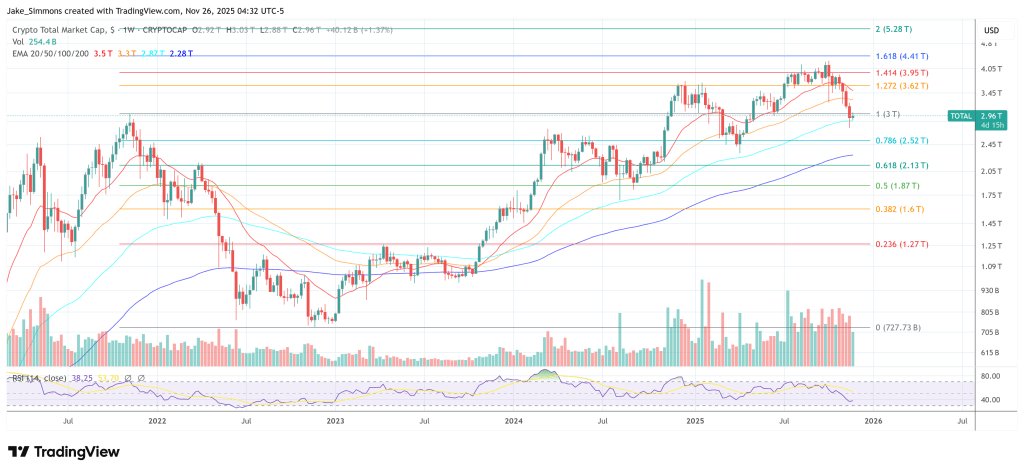
Featured image created with DALL.E, chart from TradingView.com

Editorial Process for bitcoinist focuses on providing well-researched, accurate, and impartial content. We maintain strict sourcing standards, and each page goes through thorough review by our team of technology experts and experienced editors. This ensures our content is trustworthy, relevant, and valuable for our readers.
Source link
“`
