
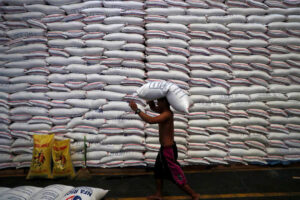

THE 15% DUTY on imported rice will remain the same at least until November, as stated by the Department of Economy, Planning, and Development (DEPDev), with the government striving for a “win-win” solution that harmonizes inflation control with safeguarding local farmers.
“Not in the short-term, but likely by November,” DEPDev Undersecretary for Policy and Planning Rosemarie G. Edillon conveyed during a news briefing on Wednesday. “After four months, we will present the study to the President.”
The reduced tariff was established through Executive Order (EO) No. 62, which became effective in July 2024 and decreased the import duty on rice to 15% from 35% until 2028. The EO requires a review every four months to evaluate its effects.
This announcement surfaces amidst a petition from agricultural groups, including the Samahang Industriya ng Agrikultura, to revert to the original 35% duty to protect local producers from the influx of lower-cost rice imports.
The Department of Agriculture, on the other hand, indicated it would advocate for a gradual tariff increase during the upcoming harvest season.
Ms. Edillon reported that they convened to discuss the review and the petition and concurred that the periodic assessment aims to report on developments rather than make suggestions at this time.
The reduced tariff seems to be accomplishing its inflation-mitigation objectives. Rice prices fell by 14.3% in June, an improvement from the 12.8% drop in May, according to the local statistics agency. It marked the steepest decline since 1995.
The rice supply also appears to be stable. As of June, the nation’s rice stockpile reached 2.24 million metric tons (MT), 3.5% higher than the previous year. “Most of them are still in the warehouses. And we actually had a bumper harvest in the first half,” Ms. Edillon mentioned.
She added that the rice import volume would be limited to 3.5 million MT for the year.
The government is also considering additional measures to assist farmers, including improved access to the Rice Competitiveness Enhancement Fund, which provides planting support.
The DEPDev is also involved in discussions regarding the restoration of the regulatory powers of the National Food Authority (NFA), which lost many responsibilities following the Rice Tarifffication Law.
Speaker Ferdinand Martin G. Romualdez stated that the House of Representatives is prepared to act on a draft bill that aims to restore the NFA’s market functions once it is presented to the chamber.
The Agriculture department has indicated that the draft legislation includes provisions for the NFA to manage buffer stocks, oversee rice marketing, and establish floor prices for rough rice.
“I believe the context was different back then. The NFA was heavily in debt and was truly suffering,” Ms. Edillon remarked, referring to the agency’s former monopoly over imports. “It wasn’t fulfilling its mandate… What we need to evaluate now is how the market has adapted to the new landscape.”
She also recognized the difficulties in establishing floor prices. “Operationalizing it and even estimating it will be very challenging. But yes, that’s something we’re investigating as well.” — Aubrey Rose A. Inosante
