

“`html


The Cardano Foundation is set to pursue two generic top-level domains—“.ada” and “.cardano”—in the upcoming ICANN application phase, aligning the network’s branding and identity with the fundamental addressing layer of the internet.
In a forum notification dated 21 October 2025, the Foundation expressed its intention to file applications in Q1 2026 and will fully fund the initiative from its resources, bypassing the Cardano Treasury. “The Cardano Foundation intends to seek the registration of the .ada and .cardano gTLDs,” the post articulates, noting that the plan has been in development since 2023, when ICANN announced a new application phase for gTLDs.
Cardano Aspires For Its Unique Niche On The Web
This move would place Cardano among a limited group of blockchain ecosystems that have autonomy over their own top-level namespace rather than depending solely on external registries or Web3-centric naming systems. The Foundation characterizes the applications as both protective and tactical: securing Cardano-oriented string(s) should mitigate the risk of brand misappropriation while establishing an entry point for identity and interoperability functionalities that connect Web2 and Web3.
If granted approval, these domains would operate similarly to any other gTLD, meaning ecosystem members could register second-level names like “vespr.ada” or “nmkr.cardano,” with the registry managed according to guidelines the Foundation states it will publish and report on consistently.
In addition to brand oversight, the Foundation stresses potential product-level integrations. It particularly highlights “streamlined wallet addresses,” integration with decentralized identity solutions “such as Veridian,” and even “domain tokenization” as areas it seeks to investigate.
The post also mentions ongoing discussions “with Ada Handles and Handshake to explore applications that connect traditional DNS and Cardano.” These instances suggest the registry could act as a foundation for human-readable identifiers that link to blockchain credentials, payment endpoints, or verifiable credentials, all within the governance and security limitations of ICANN’s DNS.
The Foundation reports that a multidisciplinary team has been formulating the plan, including consultations with community specialists and vendor assessments for both the application process and future registry management. Operationally, it proposes a Community Advisory Group to steer policy and development, and commits to “regularly publishing statistics on the gTLDs’ functioning,” in accordance with its existing transparency documents.
It also proposes the possibility that net returns, if any, could be redirected to broader ecosystem initiatives. While the post emphasizes that “there is no assurance of success,” it contends the risk is warranted by the strategic benefits and the once-in-a-decade nature of ICANN’s application cycles.
From a financial perspective, the Foundation provides an exceptionally detailed cost breakdown. It estimates one-time application fees of approximately $700,000 for the two strings, comprising about $500,000 in ICANN charges and $200,000 for application assistance. It anticipates roughly $350,000 in annual fixed costs to manage the registries, divided between ICANN fees and registry software/licensing on one end and marketing/business development/overhead on the other. Variable expenses, such as per-domain operations, would depend on sales volume and are expected to be balanced by domain income. The post reiterates, “The Cardano Foundation will cover all expenses directly,” and “will not request Cardano Treasury funds.”
To surface sentiment and provide a public signal that can be cited in the application documentation, the Foundation has submitted an “Info Action” for community voting. It urges stake pool operators and DReps to endorse the measure, asserting that visible support can enhance the credibility of a community-focused application in ICANN’s evaluation process. “Please cast your vote,” the statement encourages, adding that, if the Info Action is approved, the Foundation will move ahead with applications for both strings in Q1 2026.
As is common with most governance-related proposals in Cardano, the initiative has already sparked discussion. In the same forum thread, a community member expressed a “no” vote, citing worries about Foundation governance and the concentration of authority, particularly following the Foundation’s significant voting in Catalyst Fund 13.
The commenter stated: “I opposed this info action,” and reasoned that the “magnitude of CF’s voting influence… undermined the tenets of decentralized governance,” suggesting that an independent, community-governed non-profit could serve better as a registrar. While a single post does not represent a comprehensive sample, it reflects the contours of skepticism the Foundation may need to address, which were amplified by IOG founder Charles Hoskinson previously.
At the time of reporting, ADA traded at $

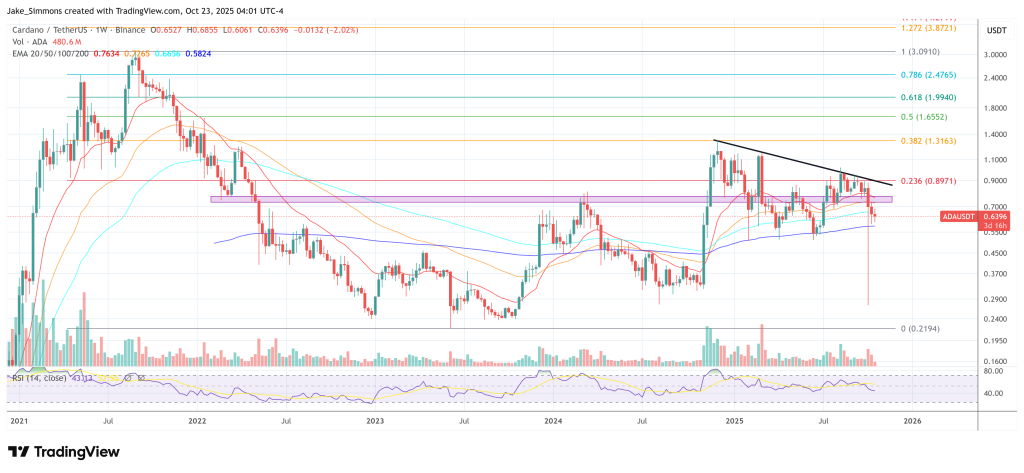
Featured image created with DALL.E, chart from TradingView.com
Editorial Process for bitcoinist is centered on delivering comprehensively researched, precise, and impartial content. We maintain stringent sourcing standards, and each page is subjected to thorough scrutiny by our team of leading technology specialists and experienced editors. This approach ensures the integrity, relevance, and value of our content for our audience.
Source link
“`