


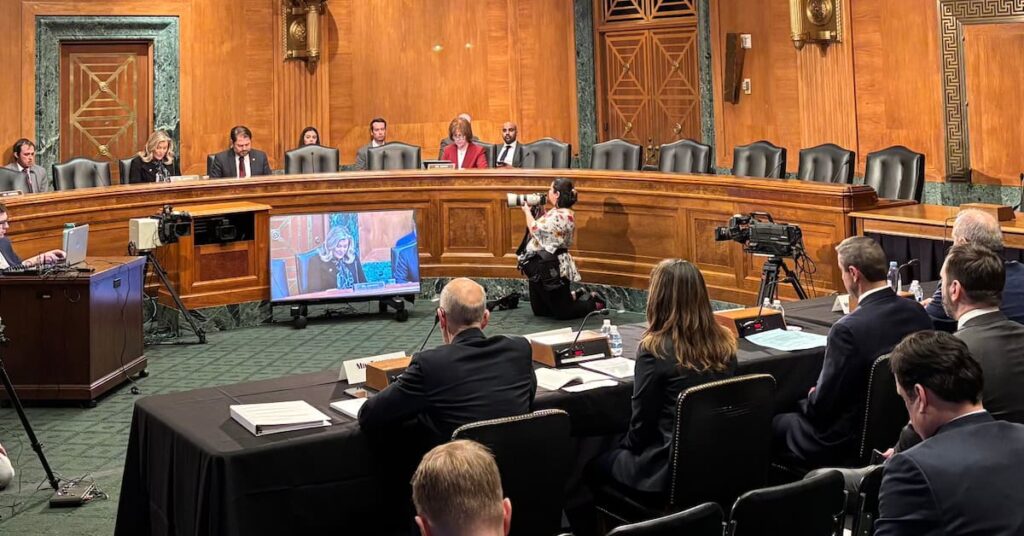
Today, the Senate Banking Subcommittee on Digital Assets conducted its inaugural hearing, titled “Exploring Bipartisan Legislative Frameworks for Digital Assets,” during which various subcommittee members and witnesses from the cryptocurrency sector primarily deliberated on the regulations concerning stablecoins.
Senator Cynthia Lummis (R-WY), a longstanding advocate for Bitcoin and the digital asset sector, led the hearing with support from the subcommittee’s ranking member, Senator Ruben Gallego (D-AZ).
The participants included Tim Massad, previous Chair of the CFTC and Research Fellow at the Kennedy School of Government, Harvard University; Jai Massari, Chief Legal Officer at Lightspark; Jonathan Jachym, Global Head of Policy and Government Relations at Kraken; and Lewis Cohen, Partner at Cahill Gordon & Reindel LLP.
Setting a proactive tone for the session, Senator Lummis expressed her determination to contribute towards passing bipartisan legislation for Bitcoin and stablecoins. (This was among the few instances in the meeting where “Bitcoin” was referenced. The other notable moment was when Massad articulated his objections to establishing a Strategic Bitcoin Reserve.)
Throughout the discussion, Massad emphasized the significance of overseeing stablecoin transactions. He proposed extending the “regulatory perimeter” to tackle AML (Anti-Money Laundering) issues linked with stablecoins and even suggested that smart contracts be structured to reduce the likelihood of misuse by malicious entities.
“[We might] program smart contracts so that transactions can’t proceed without proper vetting,” Massad commented.
He also recommended that stablecoin issuers “vigorously monitor stablecoin activities” as a method to detect any AML infractions.
Massari highlighted that authorities can also monitor stablecoin transactions since these assets operate on public blockchains. She requested reasonable regulation concerning the technology, as long as it does not become too encumbering.
“We tend to [when regulating] financial services take new innovations and force them into the existing frameworks,” she noted.
Moreover, she advocated for a “unified set of standards” to regulate stablecoin issuers, enabling users to feel more confident that all stablecoins are appropriately backed.
Jachym attempted to redirect the hearing’s attention from stablecoins to the Digital Asset Market Structure bill, asserting that it is “essential” for regulatory bodies to define clear rules regarding which digital assets qualify as securities.
However, his remarks did not gain much traction. Massad contended that discussions on stablecoins held greater importance than the market structure bill, arguing that the bill isn’t an urgent issue, as regulators can apply existing securities laws to govern crypto markets.
Jachym underscored that “the jurisdictional boundaries [concerning] digital assets should be straightforward” and claimed that “the absence of regulatory clarity in the U.S. has hindered growth [within the cryptocurrency sector.]”
Cohen offered a similar viewpoint, indicating that crypto entrepreneurs in the U.S. “constantly face the threat of litigation,” alluding to former SEC Chair Gary Gensler’s “regulation-by-enforcement” methodology.
He also communicated that the “ambiguous regulatory context has placed both consumers and users of digital assets in jeopardy.”
The sole participant during the hearing who openly contested the U.S. government’s ambition to (over)regulate digital assets was Senator Bernie Moreno (R-OH).
“The government exhibits this absolute desire to control matters,” remarked Senator Moreno, adding that several recent technologies have been applied for unlawful purposes—not solely crypto.
“Why all of a sudden, when it comes to digital currencies, have we in Washington, D.C. decided we will dictate the pace of innovation?” he concluded.
Throughout the session, subcommittee members inquired of the witnesses regarding which global jurisdictions the U.S. should emulate in crafting its digital asset regulatory framework.
Massad advocated for Europe and the Markets in Crypto-Assets Regulation (MiCA) framework, which the European Union has recently enacted, whereas Jachym suggested examining states like Wyoming, where Kraken is headquartered, to learn from the crypto legislation the state’s legislature has approved.
Although the Senators on the subcommittee and the witnesses present offered diverse viewpoints on the discussed issues, a prevailing sentiment resonated through the hearing: it’s urgent for politicians from both parties to unite and establish lucid guidelines for the cryptocurrency sector.
“Bipartisan backing for crypto policy is no longer a distant aspiration,” Jachym remarked, conveying a measure of relief.